




My research area is the physical-layer techniques for 5G and future wireless communication systems, with particular focus on precoding and hardware-informed beamforming design. Precoding usually refers to the transmit signal design that directs the desired data symbols to the intended users while limiting the inter-user interference, by exploiting the channel state information (CSI) and potentially the information of the data symbols, which has attracted significant interest in their development towards 5G. In the downlink transmission of a multi-user MIMO scenario, since users are usually separate and do not cooperate in the downlink transmission, in order to manage the potential multi-user interference, the transmitter needs to perform some signal processing techniques on the data symbols prior to transmission based on the CSI, and this is where the term ‘precoding’ comes from. Precoding approaches aims to design the precoding matrix to achieve certain targets, which include linear closed-form precoding schemes such as maximum-ratio transmission (MRT), zero-forcing (ZF) and regularized zero-forcing (RZF), non-linear precoding schemes such as dirty-paper coding (DPC), Tomlinson-Harashima precoding (THP) and vector perturbation (VP), and optimization-based precoding designs such as power minimization and SINR balancing. Precoding and beamforming designs find their applications in a variety of wireless scenarios, such as cognitive radio, physical-layer security, simultaneously wireless information and power transfer, reconfigurable intelligent surfaces, etc.
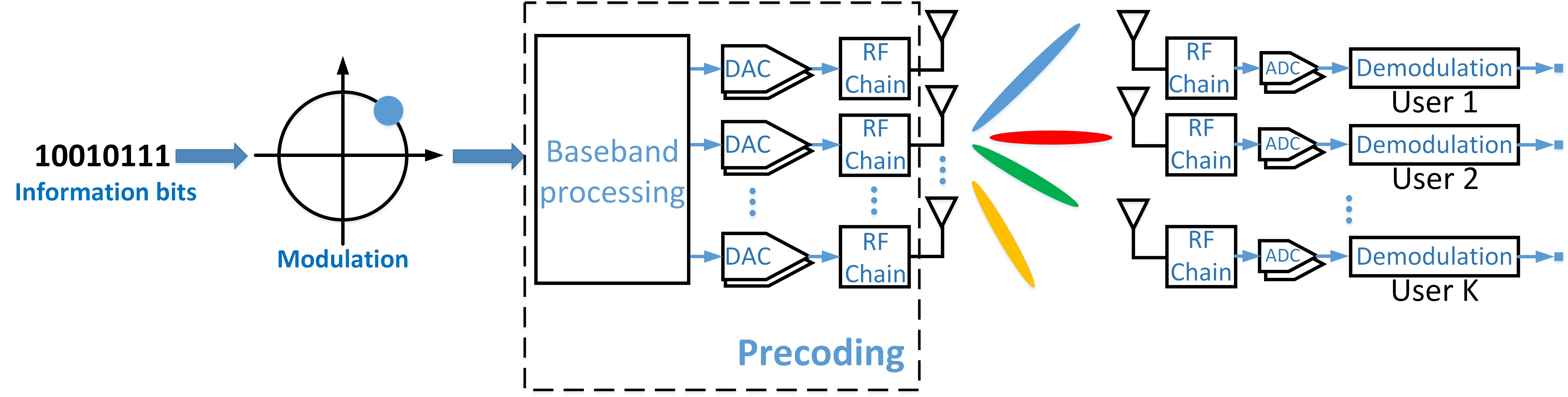
A general framework for MIMO precoding