




The capacity of modern MIMO communication systems have shown to approach the Shannon limits. To meet the ever-increasing demand for data rates in 5.5G/6G and beyond, the concept of Electromagnetic Information Theory (EIT) has recently been proposed, which aims to merge the electro-magnetics and information theory that have been studied separately for years. Pattern reconfigurable MIMO based on reconfigurable antennas is able to affect the electro-magnetic fields via reconfiguring the radiation pattern, which bridges the gap between electro-magnetics and information theory. Compared with traditional antennas with fixed radiation characteristics, reconfigurable antennas can be configured to operate with different frequency bands, different polarizations or radiation patterns, and thus can provide additional performance gains by introducing additional degrees of freedom. Among different types of reconfigurable antennas, pattern reconfigurability can improve the degree of freedom (DoF) in the signal directions so that the ability of interference suppression and energy saving can be further enhanced, while the frequency reconfigurability can reduce the interference from other wireless signals operating in the same frequency band. The polarization reconfigurability can switch between left-handed circular polarization (LHCP) and right-handed circular polarization (RHCP) to reduce the polarization mismatch and employ the polarization coding. In the field of MR-MIMO, there are two main challenges preventing the practical application of MR-MIMO. On one hand, the mode selection mechanism brings unacceptable channel estimation overhead. On the other hand, the physical mechanism of how radiation pattern of MR-MIMO affects the channel has not been revealed, and it is not clear how to design the optimal radiation pattern for capacity maximization in MR-MIMO systems. Both of the above need further and in-depth investigations.
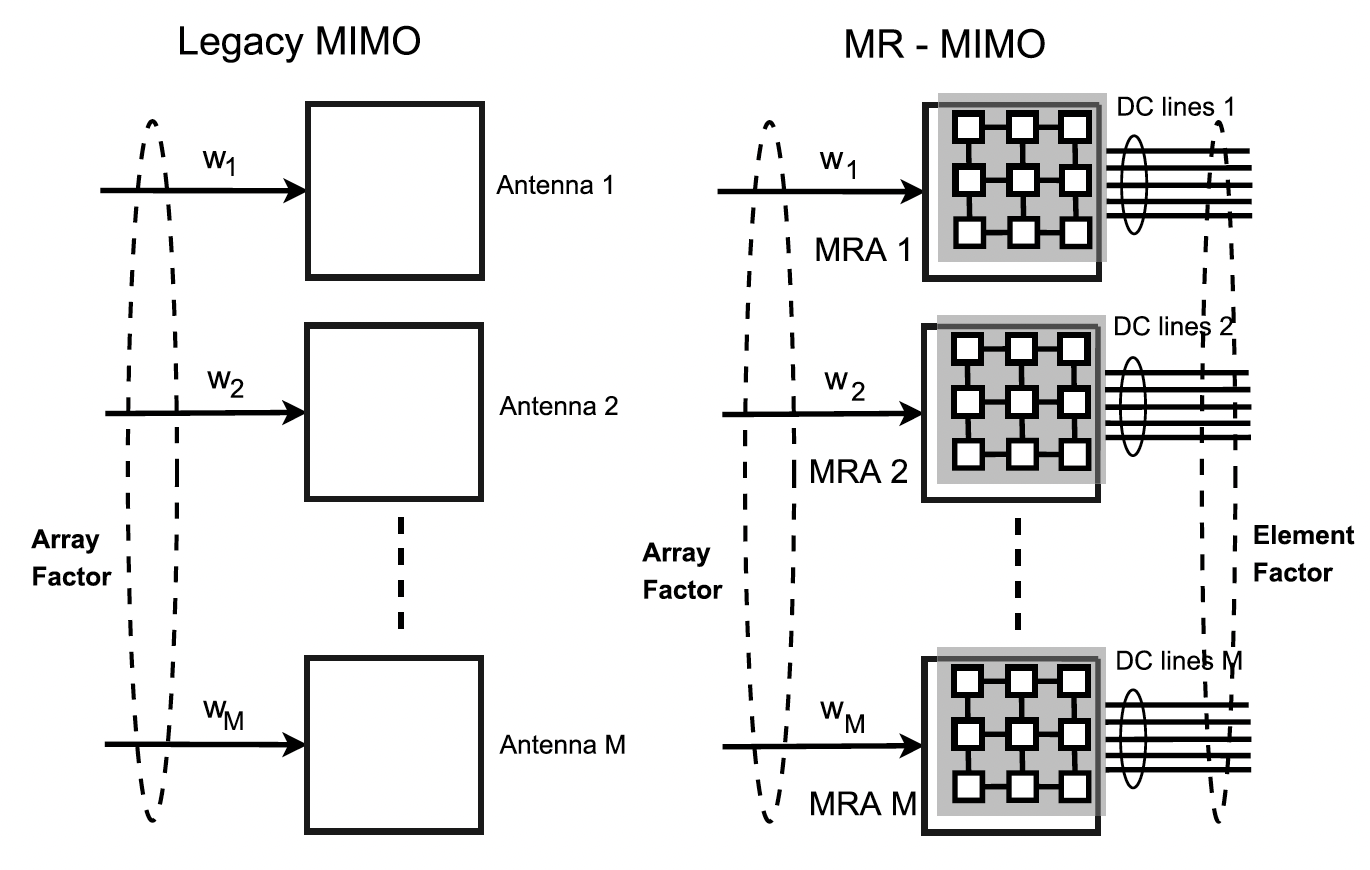
(Left) Legacy MIMO v.s. (Right) MR-MIMO