




One of my main research focus is interference exploitation via symbol-level precoding. Interference is traditionally viewed as a performance limiting factor in wireless MIMO communication systems, which is to be minimized or mitigated, as widely seen in traditional linear/non-linear precoding approaches. Nevertheless, a recent line of work has shown that by manipulating the interfering signals such that they add up constructively at the receiver side, known interference can be made beneficial and further improve the system performance in a variety of multi-user MIMO scenarios, achieved by symbol-level precoding. In the regime of symbol-level precoding, unlike tradtional block-level precoding schemes where the precoding matrix is only dependent on the knowledge of the wireless channel, symbol-level precoding exploits not only the channel state information (CSI) but also the knowledge of the data symbols that are also available at the transmitter. On a symbol-by-symbol basis, instantaneous interference can be characterized into constructive interference and destructive interference, where constructive interference is the interference that pushes the received signals away from all of their corresponding decision boundaries of the modulated-symbol constellation, which thus contributes to the useful signal power. Accordingly, the constructive region is characterized for a variety of PSK and QAM modulation, as depicted below where the green shaded area represents the constructive region.
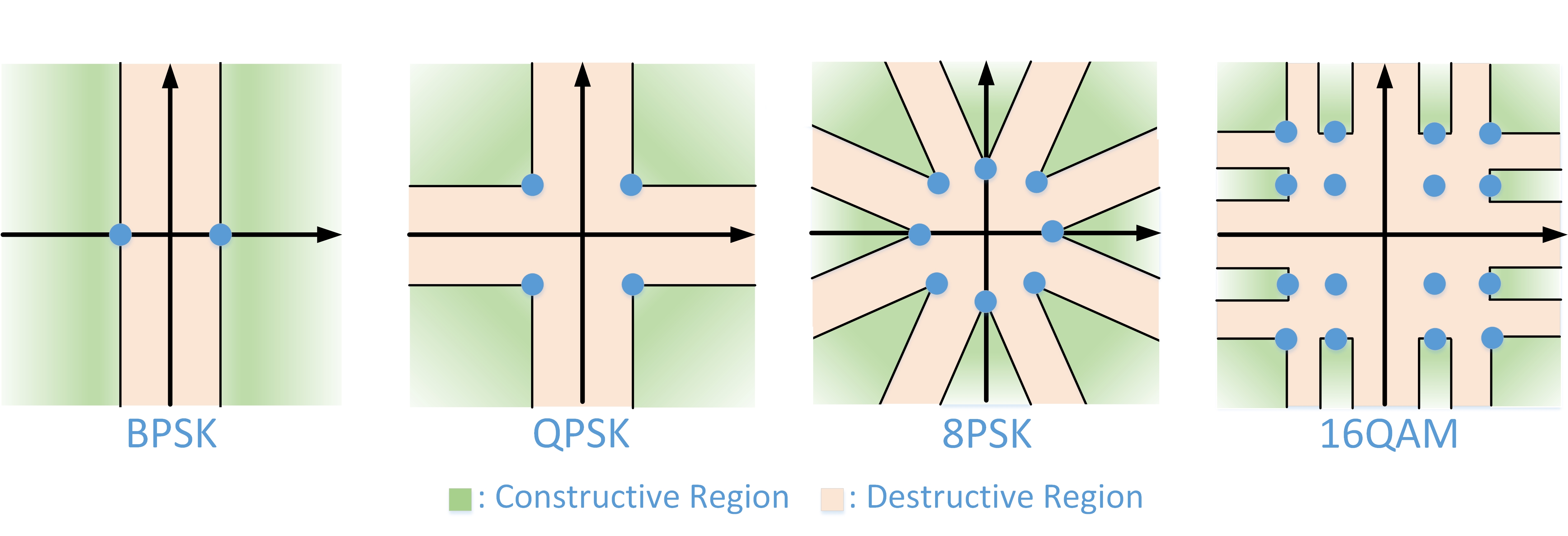
Constructive and destructive region for popular modulation types