

(四)Penning离子阱技术——量子机械振子和转子
(1) Penning 离子阱量子精密测量
机械振子和转子是经典力学里边的常见物理系统,相对应的,量子机械振子和转子其能级是量子化的,利用Penning离子阱可以构建此类量子机械振子和转子系统。Penning离子阱通过电磁场将离子进行囚禁,离子组成二维平面,通过构建二维平面的量子谐振子可以用来进行极微弱力的测量,极限灵敏度可以达到10^(-24)N。
传统的经典机械振子系统可以对加速度、角速度、压力等物理量 进行测量从而应用于惯性导航,并且此类系统可以进行微型化,所研制的传感器体积很小。相对应的,量子机械振子和转子可以应用于极微弱力测量、加速度测量、量子计算等,通过Penning离子阱构建二维离子平面晶体是研究此类问题很好的一个系统。
此外,利用离子体系对暗物质进行探测等,对超出标准模型的新物理进行探测。
(2) Penning 离子阱量子模拟
参考文献:Chen Y, Zhao L, Jiang Z. Rotation sensing with a compact Penning trapped calcium ion crystal system[J]. Bulletin of the American Physical Society, 2022. 链接
2. Penning trapped ions:Quantum Mechanical Oscillators and Rotors:
(1)Precision quantum measurement in Penning trapped ions:
Mechanical oscillators and rotors are common physical systems in classical mechanics. Correspondingly, the energy levels of quantum mechanical oscillators and rotors are quantized. Penning ion traps are utilized to construct such quantum mechanical oscillator and rotor systems. In a Penning ion trap, ions are confined by electromagnetic fields, forming a two-dimensional plane. By constructing a two-dimensional quantum harmonic oscillator, extremely weak forces can be measured with a sensitivity limit reaching 10^(-24) Newtons.
Traditional classical mechanical oscillator systems are used for measuring physical quantities such as acceleration, angular velocity, and pressure, making them applicable in inertial navigation. Moreover, these systems can be miniaturized, resulting in sensors with very small volumes. In contrast, quantum mechanical oscillators and rotors can be applied in the measurement of extremely weak forces, acceleration, quantum computing, etc. Constructing a two-dimensional ion crystal in a Penning ion trap proves to be an excellent system for researching such phenomena.
Additionally, utilizing ion systems for detecting dark matter and exploring new physics beyond the standard model is another application.
(2) Quantum simulation in Penning trapped ions:
Penning ion traps also find applications in quantum simulation.
实验平台图:
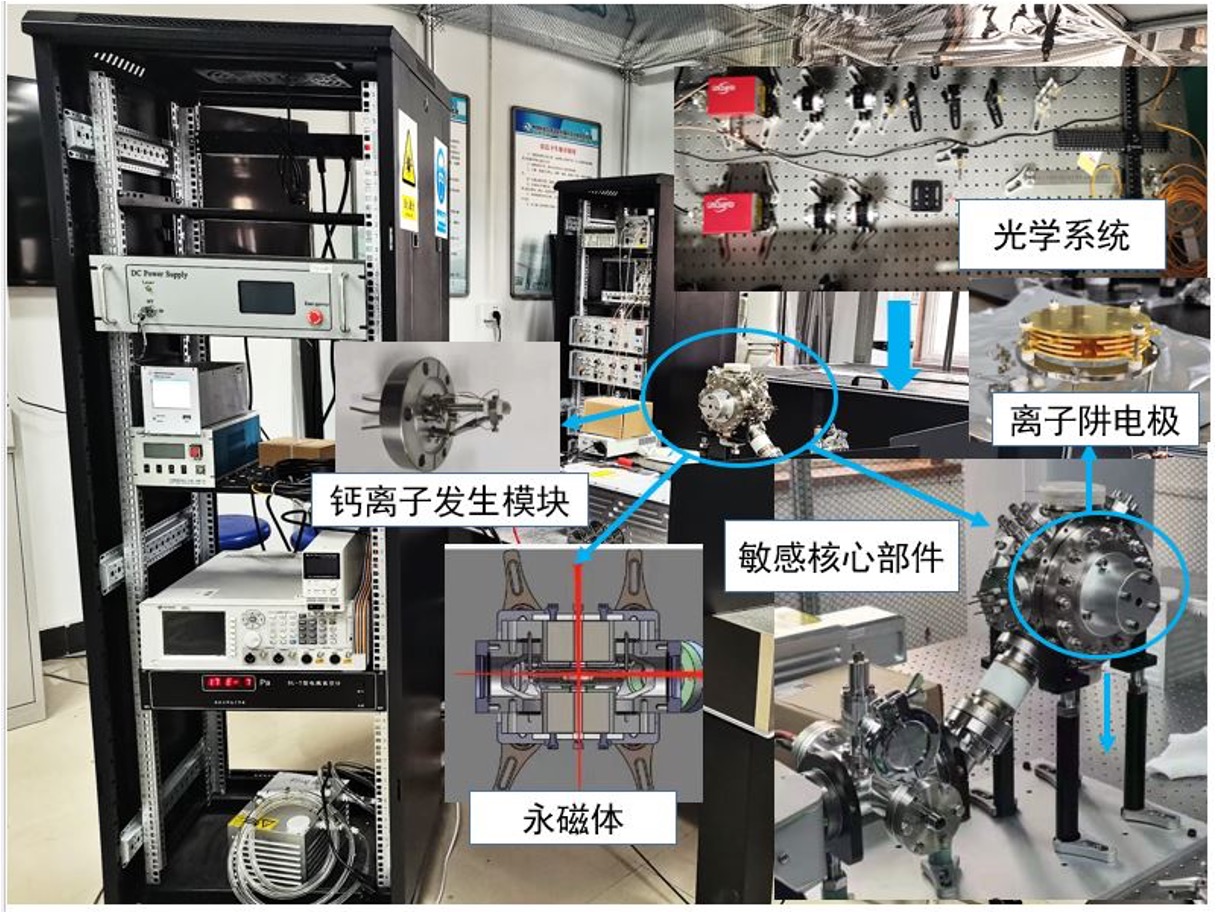
Penning trapped ions
We also focus on studying penning trapped ions. These ions are trapped in a cylendrical penning trap. They could form an ion plane as well as rotating around the magnetic field. They just looks like a rotating disk. Quantum hamonic oscillators are studied in the system. We are very intrested in using these quantum oscillators for force sensing.
(五)片上超低场核磁共振谱仪
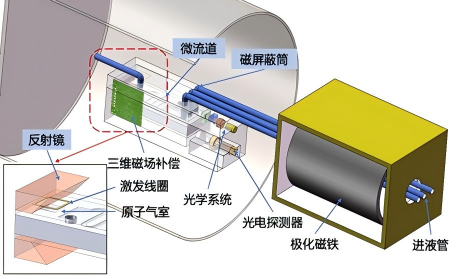
本课题组围绕片上超低场核磁共振(NMR)技术开展研究。核磁共振作为分子结构解析与生物医学成像的重要工具,传统系统依赖超导磁体,成本高、体积大。我们利用量子测量的超高灵敏优势,探索在接近零磁场下的超低场 NMR 信号探测,旨在突破微弱核自旋进动信号的高灵敏检测与噪声抑制难题,推动手性分子的精密识别与检测。研究内容涵盖晶圆级NMR敏感芯片的异质集成、基于原子吸收与磁场调制的单光束信号探测方法,以及有机分子超低场高效检测关键技术。通过结合MEMS技术,实现片上化、便携化与低成本化,为新一代超低场 NMR的前沿应用与规模化推广奠定基础。
On-chip Ultra-Low-Field Nuclear Magnetic Resonance Spectrometer
Our group focuses on the research of on-chip ultra-low-field nuclear magnetic resonance (NMR) technology. As a powerful tool for molecular structure analysis and biomedical imaging, conventional NMR systems rely on superconducting magnets, which are costly and bulky. By leveraging the ultra-high sensitivity of quantum measurement, we investigate the detection of NMR signals near zero magnetic field, aiming to address the challenges of weak nuclear spin precession signal detection and noise suppression, and to enable precise identification and detection of chiral molecules. Our research covers wafer-level heterogeneous integration of NMR-sensitive chips, single-beam signal detection based on atomic absorption and magnetic field modulation, as well as key techniques for high-efficiency detection of organic molecules under ultra-low fields. By incorporating MEMS technology, we seek to achieve on-chip integration, portability, and low-cost implementation, laying the foundation for the frontier applications and large-scale deployment of next-generation ultra-low-field NMR.