
Personal profile
暂未填写

发布时间:2025-10-01
文章标题:Carbon: Observation and manipulation of grain boundary corrugations in polycrystalline graphene
内容: https://doi.org/10.1016/j.carbon.2025.120890 我们以STM针尖作为原子级应变调控的工具,实现了多晶石墨烯畴界鼓泡的可控翻转。 •Atomic observation of misorientation-angle-dependent GB corrugations in polycrystalline graphene on vdW substrates. •Reversible buckling polarity manipulation of bubble-like corrugations realized by STM manipulation. •Symmetric and asymmetric cross-sectional profiles of GB wrinkles observed on vdW and metallic substrates, respectively. •An asymmetric strain distribution mechanism is proposed to explain the influences of intra- and inter-layer interactions. The nanoscale corrugations, which endow atomically thin two-dimensional materials with unique physical and chemical properties, universally exist in the grain boundary (GB) of polycrystalline graphene, but their structural tunability and the influence of substrate interaction require further investigation. Here, we report the atomically resolved scanning tunneling microscope observation and manipulation of GB corrugations in polycrystalline graphene with different substrate interactions. On the van der Waals (vdW) substrate graphite, the structure of the GB corrugation is dominated by intra-layer interaction arising from the misorientation between neighboring grains. It evolves from periodic bubble-like corrugations to continuous wrinkles as the misorientation angle increases. The buckling polarity of the surface and subsurface bubble-like GB corrugations on vdW substrates can be reversibly manipulated by applying an electric field through the STM tip. While on the metallic substrate Pt(111), the GB wrinkles show asymmetric cross-sectional profiles due to combined intralayer interactions from neighboring grains and interlayer interactions from the substrate. The metallic substrate also provides pinning effect preventing the buckling polarity manipulation. Additionally, a strain distribution mechanism was proposed to explain the influence of the key factors. These findings shed light on the strain engineering of graphene corrugations, which might find applications in electronic devices. This work was done by Xueyan Li (李雪妍 Ph.D candidate) and Jiaqi Yang (杨嘉琪 Master candidate). 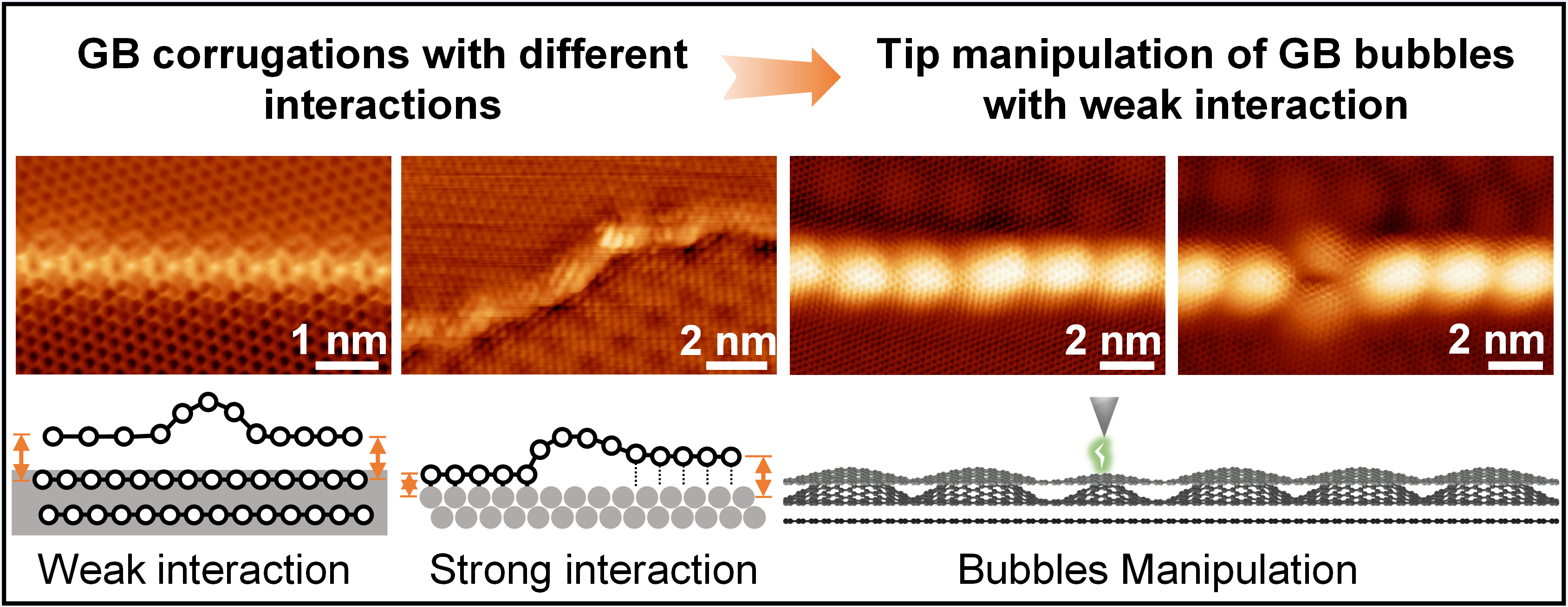
版权所有:西安交通大学 陕ICP备05001571号
