教授 硕士生导师
Department of Cell Biology and Genetics, School of Basic Medical Sciences, Xi’an Jiaotong University Health Science Center
Institute of Infection and Immunity, Translational Medicine Institute, Xi’an Jiaotong University Health Science Center
Email: jinsong.hu@xjtu.edu.cn
Tel: +86-187 1090 5160
Wechat:
ORCID:0000-0003-0565-4567 
I first became captivated by the complexities of cancer and immunology during my undergraduate degree at Shaanxi Normal Univeirsity, which led me to a PhD in Prof Zhinan Chen’s lab at the Fourth Military Medical University (Xi’an China) investigating roles of CD147 in T cell biology, and roles of the ER stress signaling pathways in protecting multiple myeloma (MM) cells from proteasome inhibitors-induced death in Prof. Karin Vanderkerken's lab at Virje Universiteit Brussel(Free University of Brussels, Brussels, Belgium). I retained a keen interest in NK (Natural killer) cell-based immunotherapy for MM during my postdoctoral research in Prof. Michale O’Dwuer's lab at the University of NUIG in Ireland, by collaborating with a startup biotechnology company ONK Therapeutics. It was during this time in we developed novel NK cell immunotherpy options for blood cancers. This research led to one of the first PCT patent to improve NK cell ability to kill cancer cells.
Since 2014, I have secured two National Natural Science Foundation of China Awards to study drug resistance mechanisms of MM cells, and the bone protection/formation roles of proteasome inhibitors in MM. And, secured one international grant supported by ONK Therapeutics to study the effects of tumor microenvironment factors on NK cells. During COVID-19 pandemic, I also COVID-19 committed to the studies of the immunopathology of SARS-CoV 2, with support of XJTU-QINLONG grant.
My research topics are at the forefront of MM, NK cells fileds, and have published high impact studies. We were the first to characterize bone marrow tumor hypoxia can be target for MM therapy (Blood, 2010, 2012; Molecular Cancer Therapy, 2014). Our research has also made key contributions for understanding the drug resistance mechanisms of MM cells to proteasome inhibitors, and the mechanisms of proteasome inhibitor-induced osteogenesis (Blood,2012; Stem Cell & Therapy, 2020). Focusing on the effects of tumor hypoxia, we dissected the cells signaling changes that impairing NK cytotoxicity (Journal of Immunology Research, 2020). In 2021, we published two highlighted articles in Journal of Leukocyte Biology, discovered that hyperactivated peripheral blood monocytes is the key determinant of the severity of COVID-19.
3. Antiviral Immunology
2022
2021
2020
2019
2018 - 2010 (Selected)
1. Teaching courses
(1)Cell biology (graduate course)
(2)Medical genetics (graduate course)
(3)Medical genetics (postgraduate course)
2. Textbook author
(1)Medical Cell Biology (4th edition), (ISBN 978-7-04-051711-8)(2019)
(2)Medical Cell Biology (4th edition), (ISBN 978-7-03-061547-3 )(2019)
(3)Medical Genetics (4th edition), (ISBN 978-7-5659-1780-6)(2018)
(4)Medical Genetics (4th edition),(ISBN 978-7-117-26939-1)(2018)
(5)Medical Biology (9th edition),(ISBN 978-7-117-26344-3)(2018)
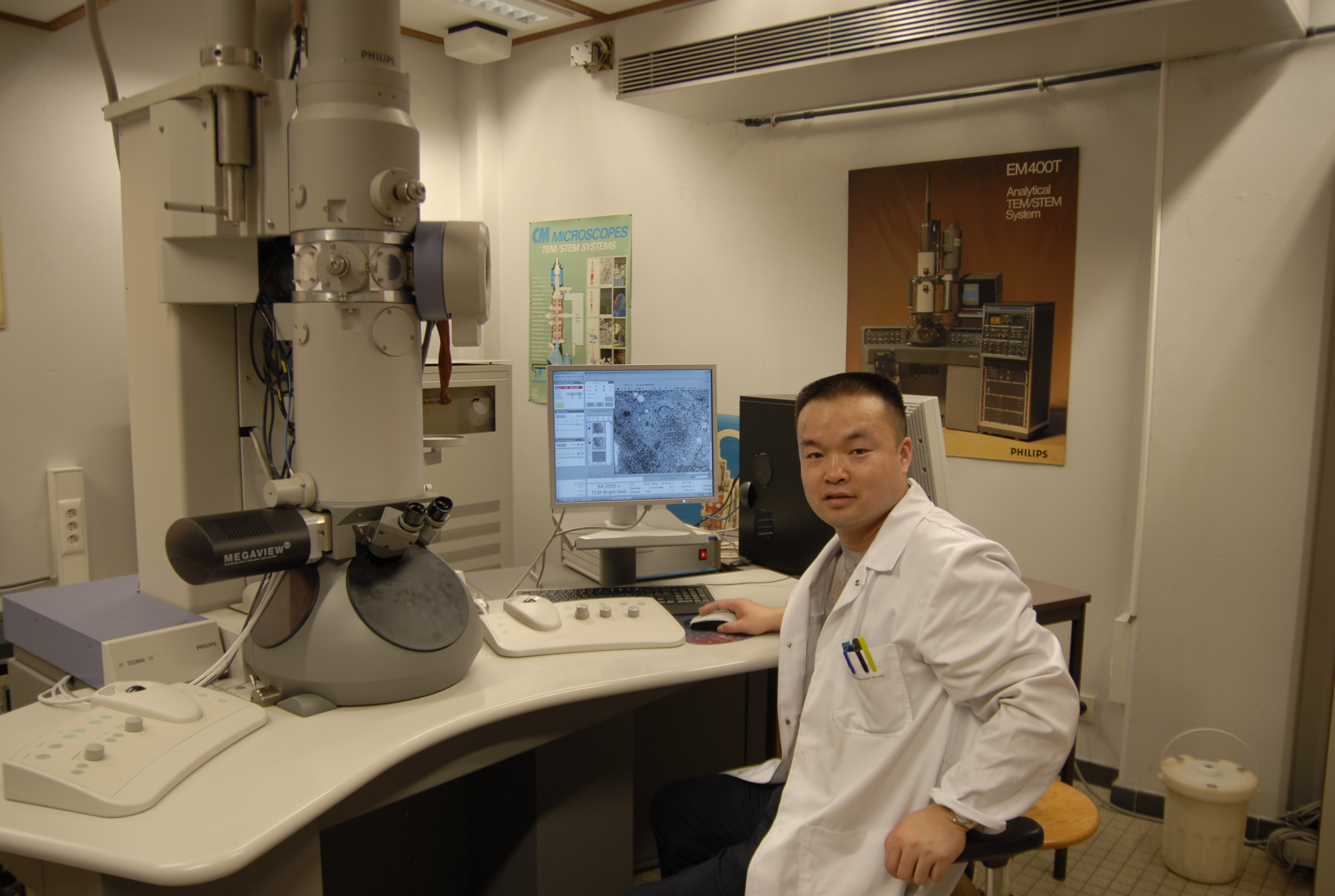
胡劲松,(双)博士、教授。
西安交通大学医学部基础医学院细胞生物学与遗传学系、西安交通大学医学部转化医学研究院感染与免疫研究所PI。
西安交通大学医学部基础医学院基础医学实验教学中心副主任。
主要从事恶性血液肿瘤、NK细胞免疫治疗血液肿瘤、抗病毒免疫机制方面的研究。既往研究成功解析了多发性骨髓瘤骨髓微环境特征、蛋白酶体抑制剂耐药以及促成骨发生机制,以及COVID-19单核细胞过度活化的免疫病理机制,相关成果发表在专业领域权威期刊Blood, Leukemia, Stem Cell Research & Therapy,Journal of Leukocyte Biology等。以第一作者或通讯作者共发表论文30余篇,被引用>1200次,H index=16。在NK细胞肿瘤免疫领域获得国际专利授权1项,国家专利授权4项。
主持国家自然科学基金面上项目2项、国际合作项目1项、省部级课题3项。