
Personal profile
暂未填写

发布时间:2024-05-15
文章标题:电网边缘的机器学习/Machine Learning at the Grid-Edge
内容: 此开源阻抗建模机器学习框架由普林斯顿大学(Princeton University)、西安交通大学(XJTU)和瑞典皇家理工学院(KTH)共同合作开发,受到普林斯顿大学H. Vincent Poor教授(IEEE Life Fellow,美国国家科学院院士、美国国家工程院院士、美国艺术与科学院院士)、Minjie Chen教授(IEEE PELS Richard M. Bass杰出青年工程师奖获得者)和前瑞典皇家理工学院(KTH)现清华大学Xiongfei Wang教授(IEEE Fellow,IEEE PELS Richard M. Bass杰出青年工程师奖获得者,IEEE TPEL主编)的支持。 InvNet InvNet: a machine learning framework for grid-edge inverter impedance modeling (InvNet framework, and the database supporting the findings of this work are all publicly available at https://github.com/superrabbit2023/InvNet). Brief Introduction The future electric grid will be pervasively formed by a vast number of smart inverters distributed at the edge of the grid. These inverters' dynamics are commonly characterized as impedances under small-signal perturbations and are critical for ensuring grid stability and resiliency. However, operating conditions of these inverters can vary widely, resulting in various impedance patterns and complicating grid-inverter interaction behaviors. Existing analytical impedance models require a thorough and precise understanding of system parameters and make numerous assumptions to reduce system complexities. They can hardly capture the complete electrical behaviors of physical systems when inverters are controlled with sophisticated algorithms or performing complex functions. Real-world impedance acquisitions across multiple operating points through simulations or measurements are expensive and impractical. Leveraging the recent advances in artificial intelligence and machine learning, we present the InvNet, a few-shot machine learning framework capable of characterizing inverter impedance patterns across a wide operation range, even with limited impedance data for each inverter. The InvNet can extrapolate from physics-based models to real-world models and from one inverter to another. Our work showcase machine learning and neural networks as powerful tools for modeling black-box characteristics of sophisticated grid-edge energy systems and analyzing behaviors of larger-scale systems that cannot be described using traditional analytical methods. How to cite If you used InvNet, please cite us with the following: [1] Yufei Li, Yicheng Liao, Liang Zhao, Minjie Chen, Xiongfei Wang, Lars Nordström, Prateek Mittal, and H. Vincent Poor, "Machine Learning At the Grid Edge: Data-Driven Impedance Models for Model-Free Inverters," in IEEE Transactions on Power Electronics, 2024, doi: 10.1109/TPEL.2024.3399776. (https://ieeexplore.ieee.org/document/10529635). [2] Yicheng Liao, Yufei Li, Minjie Chen, Lars Nordström, Xiongfei Wang, Prateek Mittal, and H. Vincent Poor, "Neural Network Design for Impedance Modeling of Power Electronic Systems Based on Latent Features," in IEEE Transactions on Neural Networks and Learning Systems, vol. 35, no. 5, pp. 5968-5980, May 2024, doi: 10.1109/TNNLS.2023.3235806. (https://ieeexplore.ieee.org/document/10021300) [3] Yufei Li, Yicheng Liao, Xiongfei Wang, Lars Nordström, Prateek Mittal, Minjie Chen, and H. Vincent Poor, "Neural Network Models and Transfer Learning for Impedance Modeling of Grid-Tied Inverters," 2022 IEEE 13th International Symposium on Power Electronics for Distributed Generation Systems (PEDG), Kiel, Germany, 2022, pp. 1-6, doi: 10.1109/PEDG54999.2022.9923064. [4] Li Cheng, Yang Wu, Xiongfei Wang, Minjie Chen, Yufei Li, Lars Nordström, and Frans Dijkhuizen, "Online Identification of Wind Farm Wide Frequency Admittance with Power Cables Using the Artificial Neural Network," 2023 IEEE Energy Conversion Congress and Exposition (ECCE), Nashville, TN, USA, 2023, pp. 1530-1535, doi: 10.1109/ECCE53617.2023.10362863. And more to come...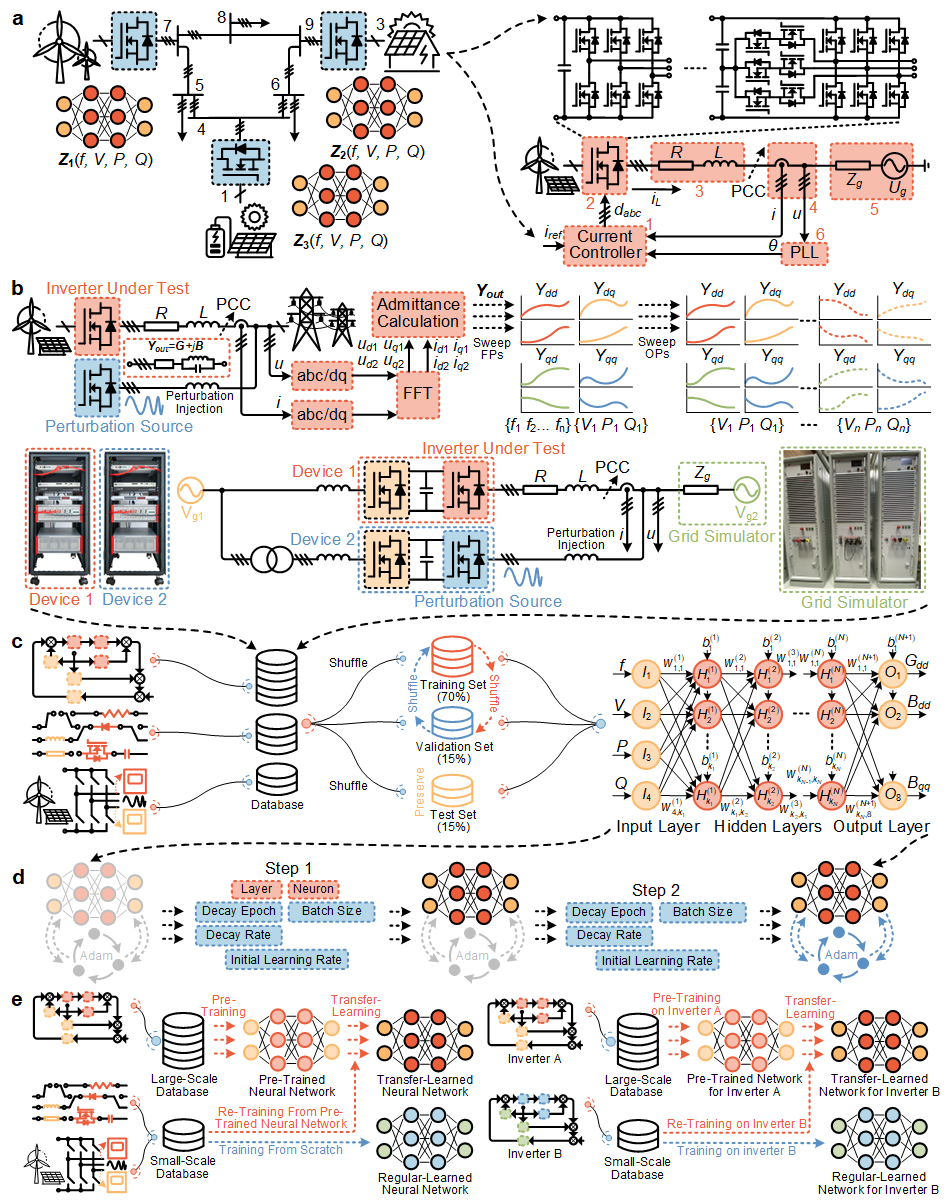
版权所有:西安交通大学 陕ICP备05001571号
