

- 教授
- 博士生导师
- 硕士生导师
- 入职时间:2011-09-30
- 学历:博士研究生毕业
- 性别:男
- 学位:博士
- 在职信息:在职
- 毕业院校:南洋理工大学
- 所属院系:人居环境与建筑工程学院
- 学科:建筑学
- 发布时间:2024-12-20
- 文章标题:团队博士张智斌关于寒冷/严寒农村地区太阳能-空气源热泵耦合供暖系统的运行设计及参数优化研究发表于能源类TOP期刊Solar Energy
- 内容:
团队博士张智斌关于寒冷/严寒农村地区太阳能-空气源热泵耦合供暖系统的运行设计及参数优化研究发表于能源类TOP期刊Solar Energy。
Dr. Zhang Zhibin published a paper titled “Optimization of design parameters and operation conditions of solar-air source heat pump coupled system for rural buildings in cold and severe cold regions” in Solar Energy.
多能互补耦合系统可以有效结合各类热源的优势,提高系统运行性能及稳定性。然而,耦合系统的复杂性对系统性能优化带来了挑战。本文通过TRNSYS开发并分析了为中国寒冷地区(北京)和严寒地区(长春)设计的太阳能-空气源热泵耦合采暖系统长期运行下的系统性能。采用响应面法(RSM)建立了不同性能指标的回归模型,并通过非支配排序遗传算法(NSGA-II)获取帕累托最优解集进行交互性能参数的多目标优化。研究发现,性能指标的回归模型(即能耗、太阳能保障率和太阳能蓄热量供热比)与太阳能集热器面积及蓄热水箱容量密切相关。通过优化得到的帕累托最优解集成功地平衡了交互性能指标的最优解范围。在寒冷地区,耦合系统的能耗、太阳能保障率和太阳能蓄热量供热比分别比单一空气源热泵系统优化了31.79%、33.00%和40.07%。寒冷地区工况优化了16.25%、15.35%和28.38%。本研究的设计方法和优化过程为太阳能与辅助热源耦合采暖系统的优化提供了设计依据。
The multi-energy coupled system can effectively combine the advantages of various heat sources, improving the system's operational performance and stability. However, the complexity of coupled systems poses a challenge to system performance optimization. In this paper, a solar-air source heat pump coupled system designed for heating in cold (Beijing) and severe cold (Changchun) regions is developed and analyzed by TRNSYS software. Response surface methodology (RSM) is employed to establish regression models for different performance indicators, and then the non-dominated sorting genetic algorithm-II (NSGA-II) is adopted to solve the multi-objective optimization of interactive performance parameters through Pareto optimal solution set. The regression models of the performance indicators, i.e., the energy consumption, the solar energy assurance rate and the ratio of heating supply from solar energy storage tank to building load, are found to be closely related to the area of solar collectors and the volumes of storage tanks. The obtained Pareto set successfully balances the optimal values of interactive performance indicators. In cold regions, P, Ar, Hs of the coupled system can be improved respectively by 31.79%, 33.00% and 40.07% compared to the single air source heat pump system. While in severe cold regions, these improvements are 16.25%, 15.35% and 28.38%, respectively. The design method and optimization procedure of this study provide a basis for the optimization of the solar and auxiliary heat source coupled heating systems.
文章链接:https://www.sciencedirect.com/science/article/pii/S0038092X24008429
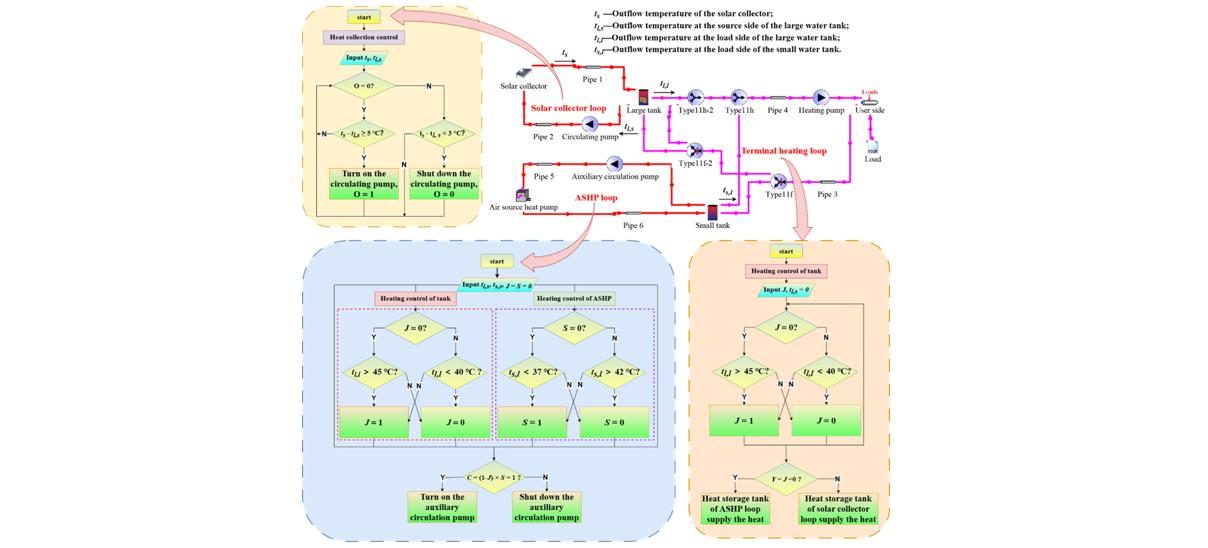
图1 多能互补耦合系统及其运行逻辑