



恭喜硕士生龙一苇的文章在Polymer Degradation and Stability在线发表
- 发布时间:
- 2021-10-01
- 文章标题:
- 恭喜硕士生龙一苇的文章在Polymer Degradation and Stability在线发表
- 内容:
恭喜硕士生龙一苇的文章“Dynamic Electrical Conductivity Induced by Isothermal Crystallization in Aluminium Hydroxide Filled Silicone Rubber”被材料老化领域知名期刊Polymer Degradation and Stability直接接收并在线发表。
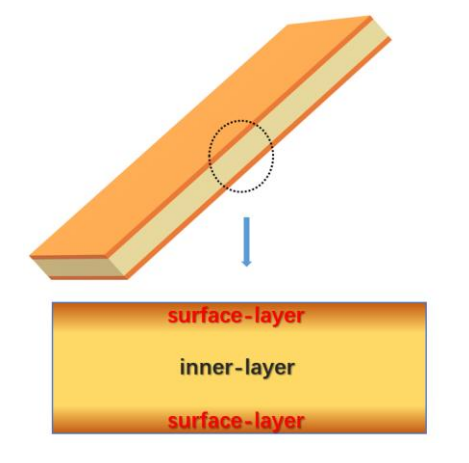
摘要:The skin-core structure of thermally aged epoxy resin consisting of the aged surface-layer and the unaged inner-layer, was studied in this paper. A new tanδ peak appeared in the results of dynamic mechanical analysis (DMA) after the specimens were thermally aged. It steadily diminished when the surface of the specimens was gradually removed, which indicates that the newly detected peak arose from formation of surface-layer during ageing. Thickness of the surface-layer could reach up to 0.09 mm after thermal ageing for 480 h. According to Fourier transform infrared spectroscopy (FTIR) results, formation of the surface-layer was found to closely correlated with thermal oxidation and re-crosslinking processes. The former induced oxidized molecular chains while the later might be related to the production of carboxylic acid dimers and etherification reactions to result in strengthened networks. This was further ascertained by the results of dielectric spectroscopy and isothermal surface potential decay (ISPD) tests. The relaxation process of aged epoxy resin displayed higher relaxation time, strength, and activation energy than unaged specimens, and evident growths of both deep and shallow level traps densities were also observed after thermal ageing. This casts new light on the thermal ageing mechanism of epoxy resin and could provide a feasible method for its insulation degradation assessment.
论文链接:https://doi.org/10.1016/j.polymdegradstab.2021.109743
“Polymer Degradation and Stability deals with the degradation reactions and their control which are a major preoccupation of practitioners of the many and diverse aspects of modern polymer technology.”