Personal Information

  • Master Tutor
  • (Assistant Professor)
  • E-Mail:

  • Administrative Position:

    Assistant Professor
  • Education Level:

    With Certificate of Graduation for Doctorate Study
  • Business Address:

    Room 112, East Building 2, Xingqing Campus
  • Gender:

    Male
  • Degree:

    Doctoral degree
  • Professional Title:

    Assistant Professor
  • Status:

    Employed
  • Alma Mater:

    Xi'an Jiaotong University

Other Contact Information

  • Email:

Papers

Home > Research > Papers

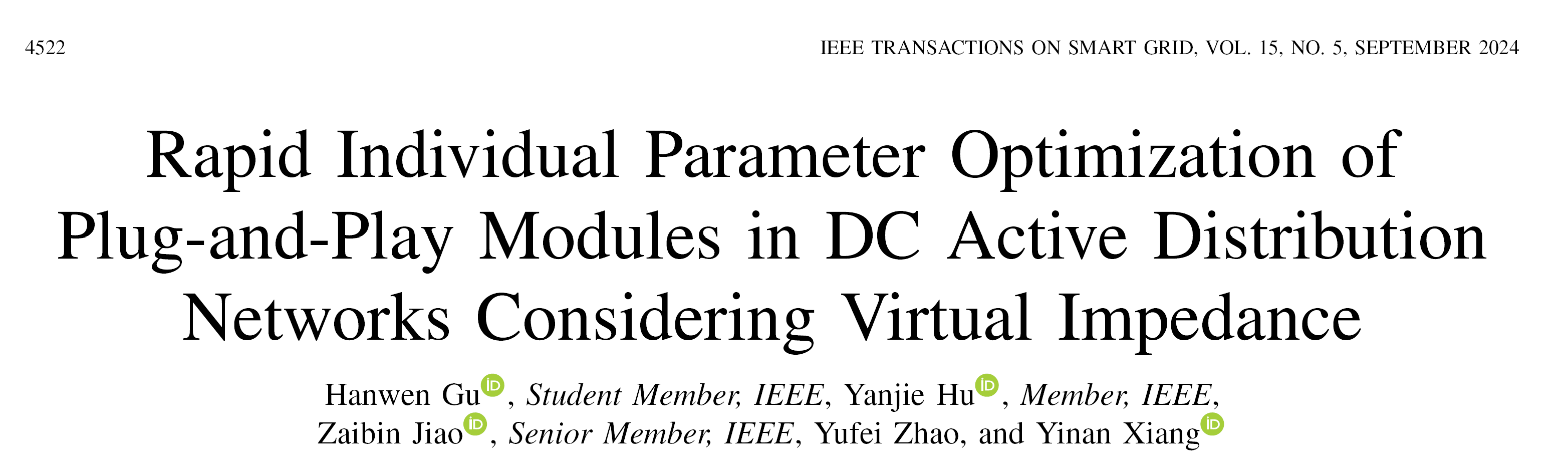
Rapid individual parameter optimization of plug-and-play modules in DC active distribution networks considering virtual impedance

  • Date:2025-11-04
  • Impact Factor:9.8
  • DOI Number:10.1109/TSG.2024.3398146
  • Title of Paper:Rapid individual parameter optimization of plug-and-play modules in DC active distribution networks considering virtual impedance
  • Journal:IEEE Transactions on Smart Grid
  • Key Words:Boundary calculation, DC active distribution networks, individual parameter optimization, plug-and-play, root loci, small-signal stability, virtual impedance
  • Summary:Plug-and-Play (PnP) operations are commonplace to enhance the resilience of DC Active Distribution Networks (ADNs). During device PnP, small-signal stability issues may arise due to inappropriate system parameters. Therefore, rapid stability adjustment is essential to realizing PnP operations. This paper presents an Individual Parameter Optimization (IPO) method to rapidly improve stability by tuning few parameters. Virtual Impedances (VIs) are considered to solve the problem that adjusting the regular operating parameters is limited or inoperable in practice. Rapid parameter boundary calculation is adopted as a less time-consuming alternative for drawing root loci to select appropriate values of dominant parameters. Firstly, for boundary calculation of control parameters, a method for distinguishing all types of root loci is proposed based on the first- and second-order Eigenvalue Parametric Sensitivities (EPSs), and then, according to different root loci, narrower initial intervals are determined to speed up Eigenvalue Perturbation Theory (EPT)-based method. Secondly, for adjustable operating parameters, the improved EPT-based method is adopted instead of the Newton–Raphson formula in traditional iteration methods to avoid solving eigenvalue problems and shorten the calculation time of EPSs. Numerical and simulation results indicate that the proposed IPO method can effectively adjust system stability, only taking a fraction of the time of traditional methods.
  • Co-author:Yanjie Hu,Yufei Zhao,Yinan Xiang
  • First Author:Hanwen Gu
  • Indexed by:Journal paper
  • Correspondence Author:Zaibin Jiao
  • Volume:15
  • Issue:5
  • Page Number:4522 - 4536, IEEE Transactions on Smart Grid
  • ISSN:1949-3053
  • Translation or Not:No
  • Date of Publication:2024-05-08
  • Included Journals:SCI
  • Links to Published Journals:https://ieeexplore.ieee.org/document/10525064
Back
Top