



陈鑫
 我的新闻
我的新闻发布时间:2020-09-14
文章标题:恭喜袁萍耘在Biomaterials发表文章
内容:
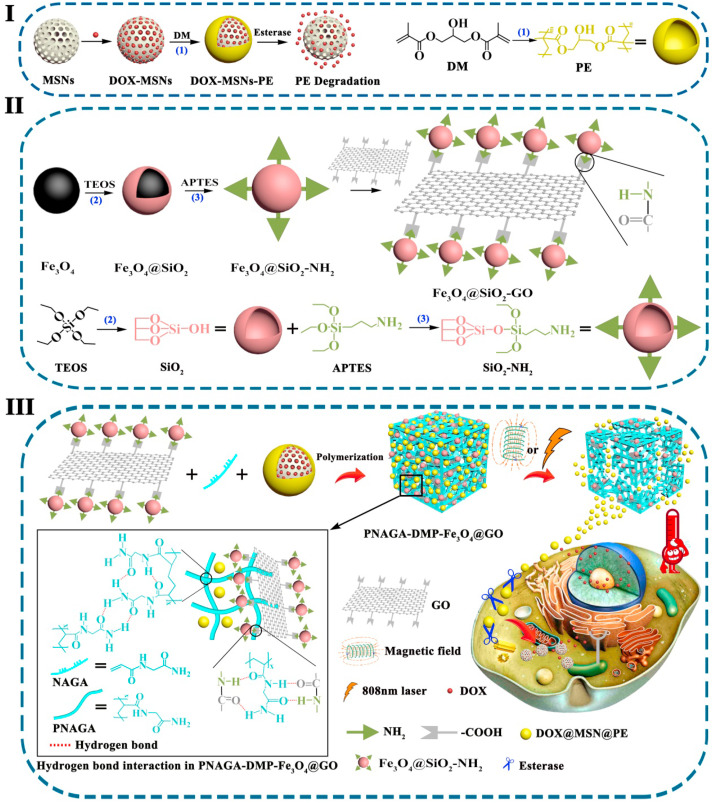
Nanocomposite hydrogel with NIR/magnet/enzyme multiple responsiveness to accurately manipulate local drugs for on-demand tumor therapy.
Abstract: Chemotherapy is one of the most commonly utilized approaches to treat malignant tumor. However, the well-controlled chemotherapy able to accurately manipulate local drugs for on-demand tumor treatment is still a challenge. Herein, a magnet and light dual-responsive hydrogel combining thermosensitive poly(N-acryloyl glycinamide) (PNAGA), doxorubicin (DOX) loaded and polyester (PE) capped mesoporous silica nanocarriers (MSNs) as well as Fe3O4 nanoparticles (Fe3O4 NPs) grafted graphene oxide (GO) was fabricated to address above issue. The Fe3O4 NPs and GO respectively serve as magnetothermal agent and photothermal agent to perform hyperthermia, meanwhile to generate chain motion of PNAGA with varying degrees under different conditions of magnetic field and/or NIR irradiation. This strategy not only allowed the gel-sol transition of the hydrogel by prior heating for tumor injection, but performed controllable release routes of DOX-MSNs-PE (DMP for short) nanocarriers to meet various requirements from different patients and the changing states of tumor. Furthermore, these escaped DMP nanocarriers could be taken by surrounding tumor cells, and then deliver their drug to these cells after rapid hydrolysis of the PE cap triggered by esterase, resulting in accurate chemotherapy. Both in vitro and in vivo results indicated that the PNAGA-DMP-Fe3O4@GO hydrogel combining well-controllable chemotherapy and hyperthermia can eliminate more than 90% tumor cells and effectively inhibit the tumor growth in mice model, demonstrating the great candidate of our hydrogel for accurate tumor therapy.
Copyright © 2020 Elsevier Ltd. All rights reserved.
https://www.sciencedirect.com/science/article/pii/S0142961220306037
