



陈鑫
 我的新闻
我的新闻发布时间:2019-06-26
文章标题:恭喜袁萍耘发表文章
内容:
Stimuli‐Responsive Scaffold for Breast Cancer Treatment Combining Accurate Photothermal Therapy and Adipose Tissue Regeneration
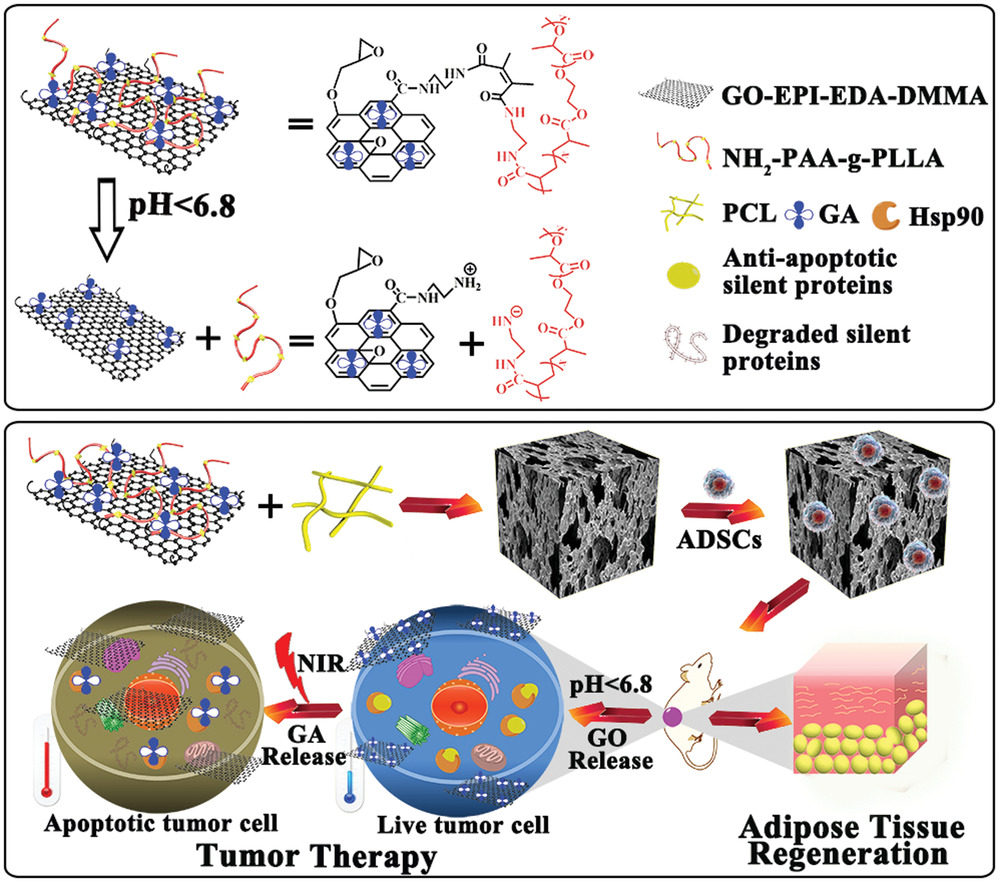
Abstract: Development of new therapeutic scaffolds to selectively destruct tumors under gentle conditions meanwhile promoting adipose tissue formation would be a promising strategy for clinical treatment of breast cancer. Herein, a stimuli‐responsive scaffold composed of polyacrylic acid‐g‐polylactic acid (PAA‐g‐PLLA) modified graphene oxide (GO) with a cleavable bond in between (GO‐PAA‐g‐PLLA), gambogic acid (GA), and polycaprolactone (PCL) is fabricated and then preseeded on adipose‐derived stem cells (ADSCs) for breast cancer treatment. This GO–GA‐polymer scaffold is able to simultaneously perform pH‐triggered low temperature (45 °C) photothermal therapy to selectively induce the apoptosis of tumor cells and significantly improve ADSCs growth without any photothermal damage. The low‐temperature photothermal therapy of the scaffolds can induce more than 95% of cell death for human breast cancer (MCF‐7) in vitro, which further completely inhibits tumor growth and finally eliminates tumor tissue in mice. Meanwhile, the prepared GO–GA‐polymer scaffold possesses the improved capability to stimulate the differentiation of ADSCs into adipocytes by upregulating adipo‐related gene expression, and significantly promotes new adipose tissue formation whether with or without NIR irradiation. These results successfully demonstrate that the prepared GO–GA‐polymer scaffolds with bifunctional properties will be a promising candidate for clinical cases involving both tumor treatment and tissue engineering.
https://onlinelibrary.wiley.com/doi/full/10.1002/adfm.201904401
