





Significance
Surface wettability depends on the molecular interaction at the interface of solid, liquid and gas phases. Materials exhibiting various superwetabilities such as the artificially fabricated superhydrophobic and superoleophobic materials have thus attracted significant research interests due to their potential applications. However, these materials only repel pure water solution and oil. On the other hand, applications related to polymers have not been fully explored owing to the difficulty in preventing the liquid polymer from adhering to a solid surface. This requires more research and understanding of the wettability of liquid polymers and solid substrates that will lead to effective control mechanisms for adhesion reduction at the substrate-polymer interfaces.
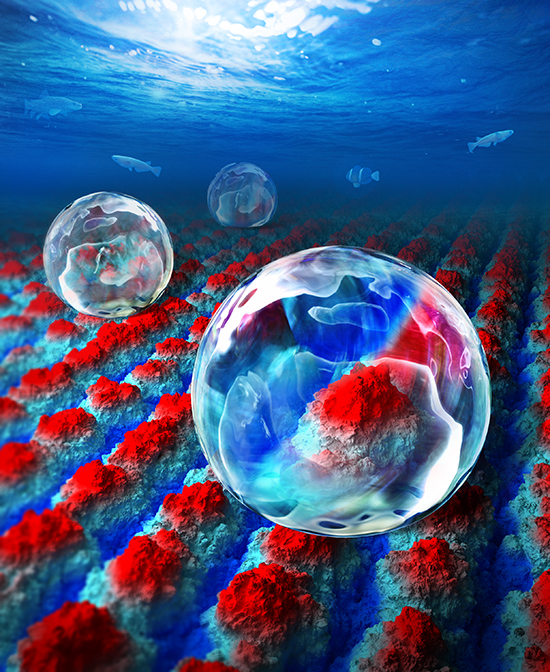
Herein, University of Rochester researchers together with their colleagues at Xi’an Jiaotong University: Professor Jiale Yong, Subhash Singh, Zhibing Zhan, Mohamed EIKabbash, Professor Feng Chen and Professor Chunlei Guo recently introduced superpolymphobicity to describe the surface that repels liquid polymer in water. Considering the significant differences between superpolymphobicity and superwetting states for water and oil, the main objective was to establish a principle for the preparation and applications of superpolymphobic surfaces. Their work is published in the journal, ACS Applied Nano Materials.
In brief, the authors commenced their work by creating a three-level microstructure on a stainless substrate using a single-step femtosecond laser processing technique. In particular, they investigated the underwater superpolymphobicity of the rough microstructure by observing the behavior of the liquid polydimethylsiloxane (PDMS) droplet when the as-prepared nanorippled surface is dipped into the water.
The laser-induced microstructures exhibited excellent underwater superpolymphobic property. The contact angle and contact angle hysteresis of the PDMS droplet on the textured surface that was reported to be 156 ± 3° and less than 4° in water respectively. As such, the liquid PDMS droplet was strongly repelled by the laser-induced microstructure. On the other hand, based on the transmission optical photographs and SEM images results, the PDMS droplet on the superhydrophilic multilevel microstructures was proved to be at the Cassie contact state also known as the underwater version.
As proof of the concept, the authors proposed a method for preparing microlens arrays by effective control of the liquid PDMS shape before curing. The resulting as-prepared microlens exhibited good imaging capacity. Additionally, it was worth noting that while the PDMS surface could adhere to the untreated surface, a single laser scanning line developed into microgroove that could not bound with PDMS in water due to superpolymphobicity. Therefore, the selective adhesion nature was successfully used to design microchannels in microfluidic systems.
Unlike the previously reported superwetabillities, the presented underwater superpolymphobicity, as stated by Professor Yong the first author in a statement to Advances in Engineering, is a promising approach for designing the shape of the polymer materials as well as selectively controlling the adhesion between the polymers and solid substrate interface. This was well demonstrated by the prepared microlens arrays and microfluidic system.


Reference
Yong, J., Singh, S., Zhan, Z., EIKabbash, M., Chen, F., & Guo, C. (2019). Femtosecond-Laser-Produced Underwater “Superpolymphobic” Nanorippled Surfaces: Repelling Liquid Polymers in Water for Applications of Controlling Polymer Shape and Adhesion. ACS Applied Nano Materials, 2(11), 7362-7371.
Yong, J., Zhan, Z., Singh, S., Chen, F., & Guo, C. (2019). Femtosecond Laser-Structured Underwater “Superpolymphobic” Surfaces. Langmuir, 35(28), 9318-9322.
Yong, J., Zhan, Z., Singh, S., Chen, F., & Guo, C. (2019). Microfludic Channels Fabrication Based on Underwater Superpolymphobic Microgrooves Produced by Femtosecond Laser Direct Writing. ACS Applied Polymer Materials, 1(11), 2819-2825.