





每秒4万亿帧:《Nature》Research Highlights专题报道课题组超快压缩成像的研究工作
- 发布时间:
- 2019-05-29
- 文章标题:
- 每秒4万亿帧:《Nature》Research Highlights专题报道课题组超快压缩成像的研究工作
- 内容:
《Nature》Research Highlights专题报道课题组超快压缩成像的研究工作:
https://www.nature.com/articles/d41586-019-01625-5
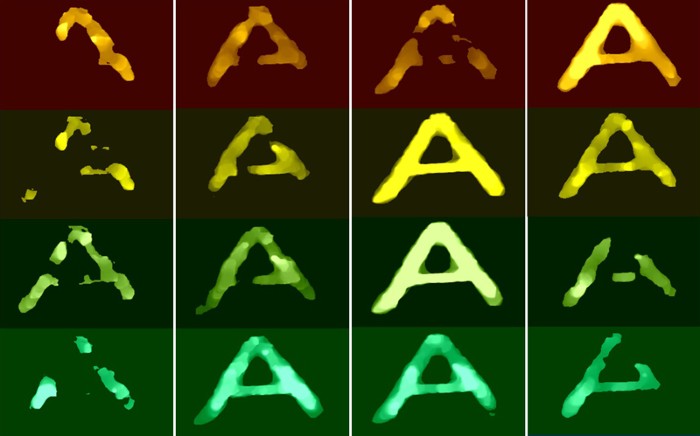
The writing of a letter A, as documented by a high-speed camera that created 4 images over the course of 12 trillionths of a second. Each colour represents an image seen at a separate wavelength of light and each column represents a particular elapsed time. Credit: Y. Lu et al./Phys. Rev. Lett.
OPTICS AND PHOTONICS
Video filmed at four trillion frames per second captures light in a flash
A new ultra-fast camera can generate a film of dozens of frames at trillions of frames per second.
High-speed cameras capture frames on light sensors composed of semiconductors. Such cameras typically save each frame of a sequence on a separate area of the sensor. But inherent limits on the sensor’s size can limit the length of a film to just a few shots.
Feng Chen of Xi’an Jiaotong University in Shaanxi, China, Lidai Wang at the City University of Hong Kong and their colleagues instead expose each frame on separate but overlapping areas of the camera sensor. Each successive frame is imprinted with a random tag before it reaches the sensor. These tags allow the image captured by the sensor to be teased apart into distinct frames.
With this technique, the camera could generate a sequence of up to 60 shots at a rate of almost 4 trillion frames per second. This allowed the team to film a light pulse as it travelled through a material.
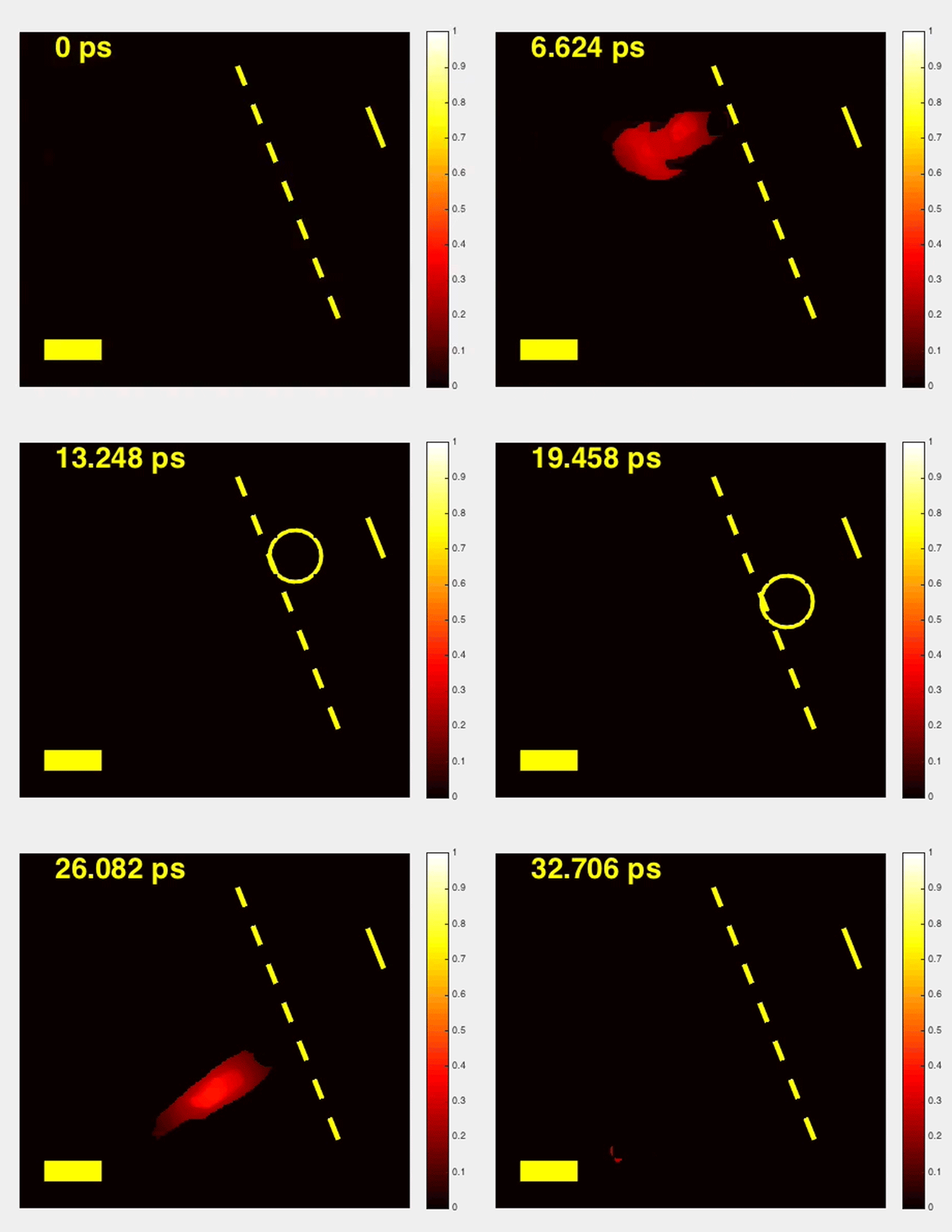
The imaging system captures a light pulse (in a slowed video) as it passes through a material, exits the material (at the dashed yellow line) and bounces off a mirror (solid yellow line) back into the material.Credit: Y. Lu et al./Phys. Rev. Lett.
The approach could be used to watch high-speed processes — such as the interaction between light and biological tissue in laser surgery — unfold over time.
